Home / Product
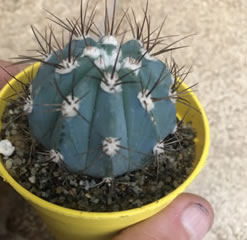
Melocactus azureus Blue cactus
€12.95
Melocactus azureus
Shipped in a 6.5cm pot
Description:
Melocactus azureus is one of most desirable of the Brazilian melocacti because of its striking frosty blue epidermis, this plant has a reputation for being more difficult to cultivate than most.
Stem:
Globose, to cylindrical (9-)14-30(-45 cm) tall and 14-20 cm in diameter, green, grey-green, never glaucous (subsp. ferreophilus) or intensely glaucous, especially when young (subsp. azureus), with mucilage present in the chlorophyllous cortical tissues
Ribs:
9-10(-12, acute, triangular in cross section.
Areoles:
1,5-2 cm apart.
Spines:
Spines black to reddish, overlaid with grey, some hooked in seedlings.
Central spines:
1-3(-4) slightly curved to straight 2-4,6 cm long.
Radial spines:
7-11 very stout, lowermost longest up to 5 cm long.
Cephalium:
3,5-12 tall, 7-10 cm wide, with white wool (subsp. ferreophilus) or brown wool (subsp. azureus) and conspicuous reddish bristles that protrude noticeably from the cephalia in subsp. ferreophilus (but never exerted in subsp. azureus).
Flowers:
Small 15-23 mm long 4-11 mm in diameter pink to magenta, with approx. 25 perianth-segments visible from above.
Flowering Time:
Spring to late autumn (fall).
Fruits:
Small, white to pale pink above 15-29 mm long, 3-10 mm across. Not produced on isolated plants (self-sterile).
Seeds:
Smooth 1-1,7 x 0,9-1,5 mm wide.
Chromosome number:
2n = 44.
Origin and Habitat:
Central and northern Bahia, eastern Brazil.
Altitude:
450-800 metres above sea level.
Habitat:
This species has a small range and is restricted to low-lying outcrops of limestone.
The species occurs in subpopulations of a few hundred individuals, however, in some there are millions.
Habitat loss for agriculture is a major threat, the vegetation gets destroyed when the surrounding caatinga forest is cleared for cultivation causing a continuing decline of the natural populations.
Also, the change in the surrounding vegetation has an impact on the outcrops were the species grows, making them prone to invasive species.
Product code: 568